
Undersea
Undersea Specialists
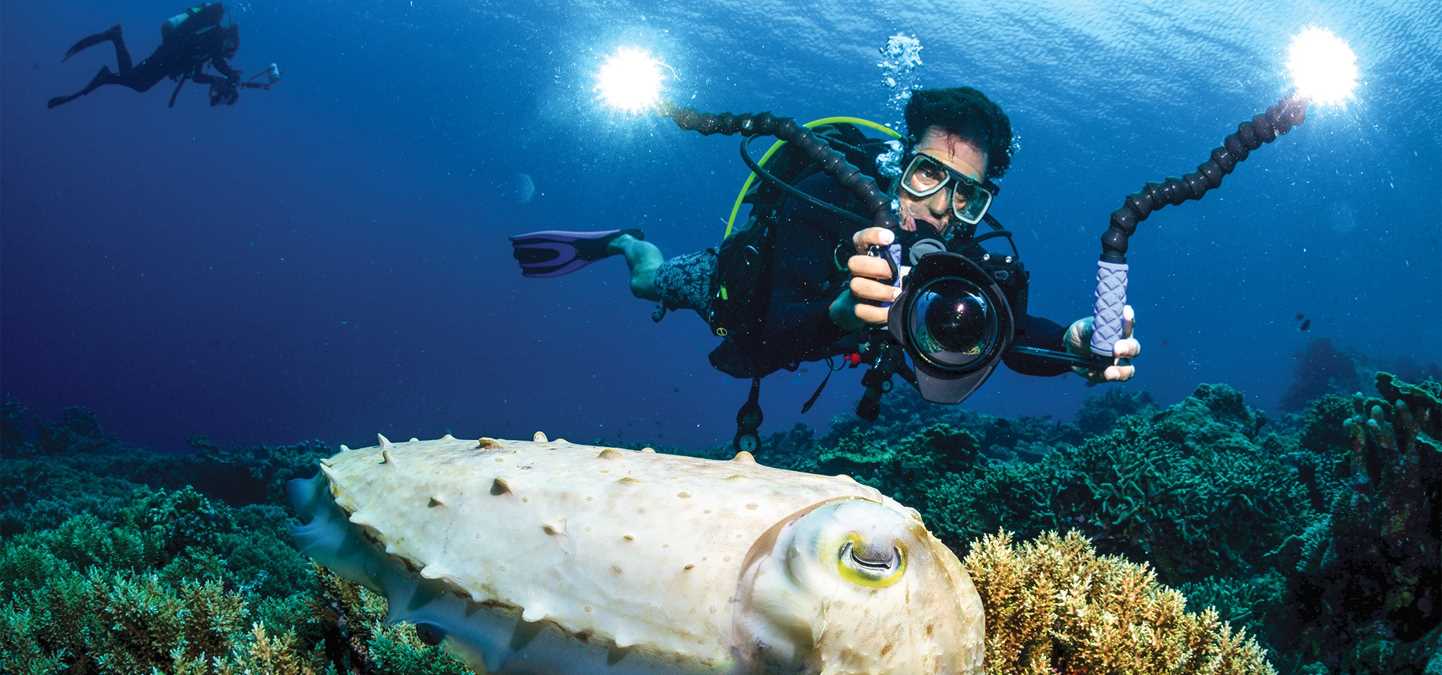
Nearly every expedition aboard the fleet sails with an undersea specialist who serves as our eyes and ears below the waves, capturing photos and videos and bringing our guests firsthand perspectives of the marine world. Throughout the voyage, they film their dives and manipulate high-definition underwater imaging equipment such as Remotely Operated Vehicles (ROVs) to reveal surprises in the ocean deep—from bright purple corals in Alaska to delicate sea stars in the frigid waters off the Antarctic Peninsula.
Their footage is shown on screens in the lounge during daily recaps, allowing guests to share in the excitement of underwater exploration and get a rare look at marine species in their habitat. In many destinations, they also accompany guests on snorkeling excursions and outings by glass bottom boat to interpret the marine world in real time.
Nearly every expedition aboard the fleet sails with an undersea specialist who serves as our eyes and ears below the waves, capturing photos and videos and bringing our guests firsthand perspectives of the marine world. Throughout the voyage, they film their dives and manipulate high-definition underwater imaging equipment such as Remotely Operated Vehicles (ROVs) to reveal surprises in the ocean deep—from bright purple corals in Alaska to delicate sea stars in the frigid waters off the Antarctic Peninsula. ...
Read more
Meet Our Undersea Specialists

 Undersea Specialist
Jason Heilmann
Growing up in northern California, Jason was surrounded by the incomparable nature of the Pacific Northwest. While attending university there, Jason met and eventually married an Ecuadorian woman who happened to be from a small group of islands off the coast of western South America. It was thus that Jason’s path led him to Ecuador and, in time, to one of the most revered natural environments on earth, the Galápagos Islands. Having found his niche in the Galápagos, and eventually becoming a professional SCUBA diver, Jason volunteered as a dive assistant on various scientific projects. Developing his enthusiasm for nature, in 1999 Jason took the only logical course: the Galápagos National Park naturalist program. Interpretation of the Galápagos, whether in the underwater realm or on land, has become a passion with Jason. Eventually he would also work as a naturalist in Alaska and British Columbia. Jason and his family also had the opportunity to take a year-long sabbatical to Sweden to continue their education in ecology and environmental communication. After almost 20 years, Jason still resides on the Galápagos Islands with his wife Graciela and son Matias. He received his Photo Instructor certification in a training workshop in 2010. Developed and taught by National Geographic and Lindblad Expeditions photographers, the workshop equipped him with the insight and skills necessary to help you better understand your camera and the basics of composition—to better capture the moments at the heart of your Lindblad-National Geographic expedition.
 Undersea Specialist
Cristian Moreno
Cristian is a Panamanian born in Chile. He grew up in Panama City until the age of 19 when he returned to Chile to go to college where he received a degree in metallurgic civil engineering. Since 1995 he has been working as a freelance naturalist in Panama. Specializing in bird watching and ecology, he also has a passion for indigenous cultures, hiking and trekking. He is a certified scuba diver and is often found exploring coral reefs along the Caribbean coast of Panama. His love for nature started at the age of 10 when he joined the Pathfinder's Club. Receiving several honors in outdoor activities, ecology, camping and others specialties he grew fond of Panama's natural heritage and was soon guiding relatives and friends through the jungles of his country. His experience is based on several years of guiding groups of different ages and interests. As a naturalist guide and expedition leader he has led groups to all corners of Panama and all along its shores.
 Undersea Specialist
Colin McNulty
Colin grew up scuba diving with his family, and fell in love with the ocean at an early age. He has been fortunate to dive in many exotic corners of the world, and to work on a number of undersea research projects studying whale sharks and several deep water fish species. After graduating from the University of Vermont, he began working in various capacities aboard expedition ships. During his travels he photographed and shared his adventures as a way of making remote areas and cultures more accessible. It was in Santa Barbara, California that he learned how to photograph underwater, and combined two of his great passions, photography and the sea. Exploring and documenting the vast richness, diversity, and beauty of the underwater world continues to be a lifelong endeavor. Colin has explored many remote destinations aboard expedition ships and icebreakers. He has lead expeditions throughout both polar regions including excursions to the North Pole. His work has also brought him to South East Asia, the Amazon, Seychelles, the Russian Far East, the South Pacific, Micronesia, the Canadian and Russian Arctic, Svalbard and Greenland. Colin also worked on a small crew filming brown bears in Halo Bay, Katmai National Park. The team spent eight weeks living among the bears, capturing their majestic beauty as they explored, fed, played, fought, and interacted with each other. Colin's thirst for adventure, love of the natural world, and devotion to the sea is evident as he strives to find new ways to bring the natural world into the hearts and minds of those around him.
 Undersea Specialist
Chris Cook
A self confessed “animal nerd,” Chris falls under many titles: marine biologist, marine interpreter, dive master, science communicator, and naturalist. Chris was lucky enough to grow up on the East Coast of Australia, where there are no shortage of different coastal environments to explore. While growing up, his friends would be surfing while he would be under the waves, snorkel and mask on looking for fish and all the weird and wonderful creatures he couldn’t get enough of. This love of the ocean lead to him completing a Bachelor of Science in 2005. His passion for the ocean and connecting people with its inhabitants landed him in various roles in different zoos and aquariums, but it was the "wild" that was always Chris’s true calling. After working as a whale watching tour guide off the West Coast of Canada and moving back to Australia to work on the Great Barrier Reef, Chris never looked back. Since 2009 Chris’s specialty has been giving presentations on and taking people out to tropical environments, in particular to different parts of the Great Barrier Reef region. In recent years Chris has spent more time living on tropical islands or on ships cruising up and down the reef than on land. Chris’s passion for photography, nature’s creatures, and scuba diving has taken him from diving in the snow in Canada one week to diving in Mexico the next. He has followed his passion to develop his photography and interpretative skills through out Southeast Asia, all along the East Coast of Australia and to the magical Kimberley region off the west coast. The only passions of Chris’s not mentioned are reptiles, birds, insects, dogs, the entire macro world, and of course talking about all of the above over good coffee!
 Undersea Specialist
James Hyde
James is a home-grown, free-range Pacific Northwest outdoorsmen. Born in Seattle and reared nearby on Vashon Island, he grew up in and surrounded by the Salish Sea. James has saltwater in his veins, but would be quick to point out we all do, echoing Carl Safina " We are, in a sense, soft vessels of seawater." Born with the travel bug, James was fortunate enough to spend time on four continents before graduating college. During his studies at Western Washington University's Huxley College of the Environment, James went to Australia and visited the Great Barrier Reef. He was never the same. A lifetime of playing in the productive, but opaque green water of the Northwest had offered him little firsthand experience of the creatures below its depths, but with a clear view of the colorful dramas playing out across the bottom of the tropical Pacific, he was hooked. Scuba diving and underwater ecology were solidified as his passion and after college, it took him to a dive shop in Seattle fixing gear, tidepooling with local middle school students, and generally making a spectacle of himself in the surf. Then unaware of expedition travel, James longed to blend his love for travel, conservation, and the marine environment. After a tip-off and a reference from a childhood friend he joined the Lindblad Expeditions' team in 2016 as a Dive Buddy. Working across the fleet as a Naturalist and Expedition Diver, James learned all he could about the ecosystems of the beautiful and remote places our ships visit. Finally becoming an Undersea Specialist, he continues to be fascinated by the Ocean and all that is in it. He hopes to inspire conservation of the beautiful and unusual ecosystems that flourish in protected waters. Additionally, he hopes to further the contributions Lindblad Expeditions and National Geographic make to the scientific community by engaging in citizen science projects, monitoring for ocean plastics in remote locations, and being involved with other partnerships from Universities, to Research Institutes, to conservation groups worldwide.
 Undersea Specialist
Rory Mulloy
Rory’s underwater experiences began while working on a citizen science project in Tobago, conducting surveys of coral reefs with Coral Cay Conservation. After completing a degree in foreign languages, and returning to his hometown London, it wasn’t long before Rory felt the lure of the ocean. Thanks to serendipitous circumstances (and some words from President JFK) he soon quit office life to pursue his dream job of working with great white sharks in Australia. After moving to Australia, he spent several year leading expeditions in the wild Southern Ocean conducting research and making films on great white sharks. He gained a Masters in Marine Science from James Cook University, completing a research project on shark repellent technologies. He then began his career with Lindblad, first to the Arctic, then South America, and eventually to Antarctica, South Georgia, and the South Pacific. Rory has also worked for Reef Check Australia leading reef health monitoring surveys and coordinating volunteer and conservation projects around South East Queensland. In 2020 he commenced a PhD in Ecological Engineering, which involves the building of a ‘Living Seawall’ in the Port of Gladstone, at CQUniversity where he also works as a researcher on coastal ecosystems.
 Undersea Specialist
Kayvon Malek
California native and “phyco-semantic” Kayvon Malek discovered his love of oceans when taking a scuba course during his time at UC-Santa Cruz. Four years later he had assisted in teaching every level of scuba at the UCSC and was working as a research diver assisting various labs and researchers at the University. After graduating, he began working at the Monterey Bay Aquarium as a diver and ocean ambassador. There while feeding leopard sharks, taking children with disabilities surface-scuba diving, and teaching children about marine protected areas, he discovered a new passion when gifted a GoPro: bringing the ocean to his ocean-less loved ones through underwater photography. This new passion quickly turned into obsession, and then primary occupation. When not assisting with marine research or trying to convince aquarium visitors that rockfish are cool too, Kayvon could be found underwater with his increasingly bulky and expensive camera system trying to make sea cucumbers look majestic. Now nearly 10 years since that first dive and his career as a Subtidal Paparazzo as robust as a Californian kelp forest, Kayvon brings oceans ecosystems to the public at large working as an Undersea Specialist with Lindblad Expeditions. He also has branched into the world of blue-chip nature documentaries and has worked on titles such as Our Planet on Netflix and other upcoming series. It is through his work here at Lindblad and on documentary films that he hopes to inspire ocean conservation by uncovering an often secretive, hidden world so that we may understand, cherish, and conserve the life it contains.
 Undersea Specialist
Amy Malkoski
Amy was raised near Cape Cod in coastal Marion, Massachusetts, and her relationship with the ocean and nature has always been an active one. Her parents, avid divers and marine biologists, introduced her to the underwater world when she was very young and she grew up participating in as many water-related activities as possible. Amy spent her summers sailing and exploring intertidal areas of Buzzards Bay. At age 12 she became a certified diver and is now a divemaster with the National Association of Underwater Instructors (NAUI). In high school her passion for nature and art developed into a love of photography, using the medium to share her explorations with others. Amy studied visual arts with a concentration in photography, as well as studying anthropology and sociology at Roger Williams University in Rhode Island. While studying, she worked as a lab assistant at a shellfish hatchery in Rhode Island where she gained experience in the husbandry, reproduction, and planting of shellfish, with a focus on oysters. Her interests in the undersea, photography, and the study of cultures have allowed her some wonderful experiences, including developing and leading a land tour and diving trip to the Azorean Islands of Portugal. She has dived and worked in Roatán, Honduras, throughout the U.K., and in the cold waters of Arctic Svalbard, Greenland, the Norwegian fjords and Iceland. Since joining Lindblad Expeditions, Amy has pursued her love for cold water diving and exploring unique regions. Her appreciation for the diversity of life, culture, and art means she’s always looking forward to the next adventure. Quite at home on the sea, she hopes to share her passion with others and inspire in them a love for nature and all of its inhabitants.
 Undersea Specialist
Maya Santangelo
Maya was born and raised in Southern California, where her curiosity for the natural world was encouraged from an early age. Relocating to Sydney, Australia with her family at 11 years old, she learned to scuba dive, eventually becoming a PADI Instructor. Her fascination for the underwater world undoubtedly fueled her interest to study marine biology at James Cook University. Working as a professional guide in some of the world’s top dive destinations, including Palau and Mexico’s Guadalupe Island and Revillagigedo Archipelago, Maya realized a passion for sharing her love for the ocean with others, and the value of citizen science in the dive industry. In 2016, Maya was awarded the Rolex Scholarship for Australasia by the Our World-Underwater Scholarship Society. Diving around the world for a year to work alongside leaders in dive expeditions, marine research and conservation, her experiences as a Rolex Scholar proved to be formative in cementing her passions and future career directions to make a difference for our blue planet. With an underlying drive to explore and understand life in the ocean, Maya’s aquatic endeavors have seen her diving and working on projects in a variety of marine environments across all seven continents. Whether counting the arms of giant sea stars in Antarctica, or identifying manta rays in French Polynesia, Maya is happiest when underwater. As part of the Lindblad Expeditions team, Maya looks forward to each dive as a new opportunity to share what would otherwise be out of sight-out of mind, and contribute to conservation through science, communication and education.
 Undersea Specialist
Christine West
Christine was fortunate to grow up in the Pacific Northwest on the shores of the Puget Sound. After graduating from the University of Washington, she decided to pursue her love of the ocean and exploration. Her passion for marine biology has inspired her through over 4,000 scuba dives around the globe in temperate and cold-water conditions, as well as snorkeling and freediving in extraordinary habitats such as in river beds with spawning salmon, in recently de-glaciated bays and lagoons filled with ice and glacial silt and in deep blue water with large marine animals including humpback whales, hammerhead sharks and pilot whales. Christine is now a USCG certified 100-ton Captain and has traveled internationally full-time as a naturalist, underwater videographer and photographer, expedition leader, educator, PADI Scuba Diving Instructor and Divemaster for over a decade. Since 2013, Christine has spent her summers working as a naturalist in several regions in Alaska including the Kenai Peninsula, the Inside Passage, Ketchikan and Denali National Park. Her experiences guiding in remote regions around the state have taken her hiking through lush riparian forests, kayaking alongside orca whales and canoeing through ice chunks near calving glaciers. She has also enjoyed working as an in-water guide educating about echinoderms and other invertebrates in the kelp forests of Southeast Alaska. Christine’s interest in travel and wildlife has taken her to work above and below water in over 30 countries, spending significant amounts of time in Alaska, Hawaii, Costa Rica, Mexico, Turkey, Thailand, Vietnam and several countries in the Caribbean.
 Undersea Specialist
Brett Garner
Brett is a photographer, marine biologist, and educator from California. He is happiest underwater with camera in hand working to inspire marine conservation. He has worked and traveled extensively throughout the Americas, Asia, Oceania, and the Middle East. His underwater work has taken him under the ice in Alaska and also through some of the world’s warmest seas. He earned his undergraduate degree from UCLA in marine biology and his master’s from Scripps Institution of Oceanography in marine biology and conservation. While at Scripps, Brett received a Rapid Ocean Conservation Grant from the Waitt Foundation to produce the multimedia project, Kia Over There , which follows a group of Fijian spear-fishermen and exposes the challenges they face to protect their reef. He followed this work with projects featuring traditional landowners in the Peruvian Amazon and nomadic fishermen in Malaysian Borneo. During the 2017 bleaching event on the Great Barrier Reef, Brett was on site documenting the changes daily. His work has been featured in publications including the New York Times , the BBC , the Sydney Morning Herald , and the Outdoor Journal. He lives on the coast in Western Australia where he can enjoy the ocean even when he isn’t working.
 Undersea Specialist
Adam Maire
Naturalist, underwater videographer, captain, and historian, Adam Maire is dedicated to exploring around the globe with a goal of researching, documenting, and teaching others about the beauty, the power and the importance of the earth’s wild places. With degrees in animal science, history and a Scuba Diving Instructor certification, he is passionate about finding extraordinary ways to help others understand the links between the worlds that exist both above and below the surface of the ocean. As a temperate and cold-water diver, he is able to capture video and images of rarely seen marine life to create real connections with the underwater world. Growing up working outside on a cattle ranch in Nebraska, Adam’s love for nature started early in life. Through college he continued to learn about the natural world and sought out jobs that aided in his thirst for knowledge. After college, he joined the US Army and afterward began working around the world as a naturalist guide. Adam’s interests have taken him on great adventures in remote locations, spending several years as a backcountry expedition guide in Alaska, leading multi-day whitewater rafting, hiking and kayaking adventures—even scuba diving in glacially-fed lagoons with harbor seals and sea otters. He has enjoyed a vast array of incredible experiences from leading horseback wildlife tours through the jungles of Nicaragua observing howler monkeys and sloths to teaching scuba diving around isolated islands in South East Asia. In 2012, Adam made the Big Island of Hawaii his home, one of his favorite places to observe and photograph marine life such as coastal manta rays, pilot whales, humpback whales and tiger sharks. Pursuing his deep interest in marine biology, Adam earned his US Coast Guard Captain’s license in 2015. Being a Captain has enabled him to spend more time in and on the water, allowing better opportunities to understand and research the marine environment.
Showing 12 of 27