Science at Sea
Taking Knowledge Further
Get an inside look at innovative science and conservation projects
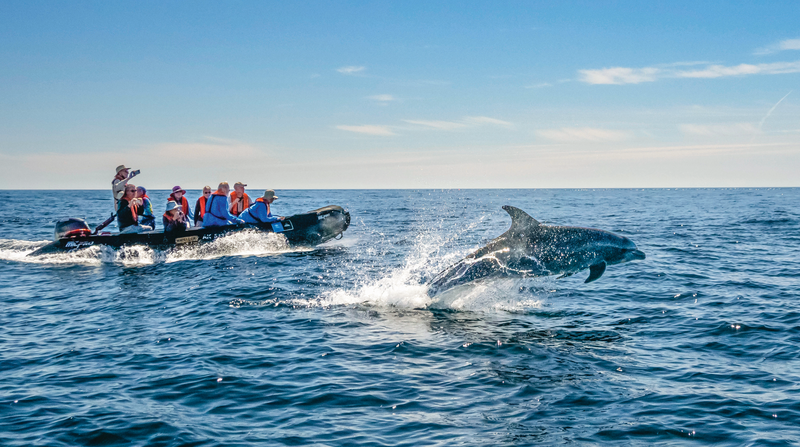
The ships in the National Geographic-Lindblad Expeditions fleet are not only equipped for adventure—they also host important research and conservation work as part of the Visiting Scientist Program. This innovative initiative allows scientists to use the fleet as a platform to build and foster their research endeavors in places like Antarctica, the Arctic and Galápagos.
The Visiting Scientist Program has been active for years, and in response to the program’s popularity with guests, National Geographic-Lindblad Expeditions is expanding it for the upcoming travel seasons. Now, more travelers than ever before can voyage alongside fascinating researchers, enjoy talks on their findings and, in some instances, participate in the scientific process through activities such as data collection.
New and Ongoing Research Projects
National Geographic-Lindblad Expeditions has supported projects that take place all over the world. From manta rays to microbes and microplastics, we are excited to support and collaborate on research projects in regions where our fleet explores.
Undersea Realms
Quantifying functional redundancy among Antarctic plankton
Whether an ecological community can withstand an external perturbation such as rapid climate change is believed to be related to the amount of functional redundancy within it. Functional redundancy refers to the presence of multiple species playing similar “roles,” such that the loss of one species can be offset by another, ecologically comparable species. This project aims to assess the potential impacts of ongoing warming along the Antarctic Peninsula by quantifying functional redundancy among the region’s plankton. National Geographic Explorer Daniel Dick will be joining the National Geographic Resolution in November 2025 for this project.
Undersea Realms
Exploring the remote cold water to find out how mollusk shells may face future climate change
This project studies how environmental conditions and pollution driven by climate change and human activities affect shelled marine organisms like limpets and mussels. Mollusk specimens along with seawater and sediment samples will be collected to understand cold-water shell growth, contaminant accumulation and the impact of ocean acidification. These data enable comparisons of biological responses between organisms living in polar and temperate seas. National Geographic Explorer Arianna Mancuso and her team will be joining the National Geographic Resolution in December 2025 for this project.
Undersea Realms
Mapping microplastics and microfibers in water and air
Rozalia Project for a Clean Ocean has been investigating the problem of microplastic and microfiber pollution and developing solutions for a decade. One of those solutions is CSI for the Ocean: A Global Citizen Science Microplastic Mapping and Monitoring Program. As part of this effort, the research team leads guests in exploring microplastics and anthropogenic microfibers that could be floating on the ocean’s surface or suspended in the air. National Geographic Explorer Rachael Miller will be joining the National Geographic Resolution in November 2025 for this project.
Undersea Realms
Detection of marine non-native species along Antarctic region vessel pathways
Antarctic and South Atlantic waters are warming twice as fast as the global average, creating unprecedented opportunities for invasive species to colonize these pristine ecosystems. Environmental DNA extracted from seawater is a highly sensitive monitoring tool for assessing the potential presence of invasive non-native species along expedition routes in Antarctica, South Georgia and the Falklands. This project establishes crucial baselines for future conservation efforts and protection of unique marine environments. National Geographic Explorer Alessandro Ponzo and his team will be joining the National Geographic Resolution in October 2025 for this project.
Undersea Realms
MicroWorlds – Revealing Antarctica’s hidden microbial life
This project investigates the hidden world of polar microbes to understand how they survive in extreme environments. Using innovative cultivation techniques, the research team reveals unseen microbial diversity and explores how these tiny—yet essential—organisms will respond to a changing climate. Cultures grown during the expedition will be deposited in international collections, creating a lasting resource for future scientific efforts in polar ecology, climate resilience, and conservation. National Geographic Explorer Catherine Ribeiro and her team will be joining the National Geographic Resolution in January 2026 for this project.
Environment
Permafrost occurrence and influence on water quality in the Southern Ocean Region
Permafrost is an important source of water that is not directly observable, and its presence and changes are difficult to assess. Thawing permafrost causes ecosystem changes, particularly for water quality and biota due to increased solutes and heavy metals. This project assesses the occurrence of permafrost and its impact on freshwater quality in remote areas, utilizing ground and water temperature measurements and chemical analyses. Visiting Scientist Raul-David Serban and his team will be joining the National Geographic Endurance in October 2025 for this project.
Environment
Extreme Ice Survey: Antarctica
In 2014, Lindblad Expeditions helped photographer and climate activist James Balog bring his Extreme Ice Survey (EIS) project to the Antarctic. Part of a global array of weatherized cameras aimed at glacier faces, EIS units harness the power of hourly time lapse photography to monitor ice movement. The project now has 11 years of uninterrupted imagery from numerous glaciers, which creates a visual record of glacial dynamics and climate change on the Antarctic Peninsula and South Georgia Island.
Environment
Mapping microplastics and microfibers in water and air
Rozalia Project for a Clean Ocean has been investigating the problem of microplastic and microfiber pollution and developing solutions for a decade. One of those solutions is CSI for the Ocean: A Global Citizen Science Microplastic Mapping and Monitoring Program. As part of this effort, the research team leads guests in exploring microplastics and anthropogenic microfibers that could be floating on the ocean’s surface or suspended in the air. National Geographic Explorer Rachael Miller will be joining the National Geographic Resolution in November 2025 for this project.
Environment
Searching for synthetics
This project investigates micro-trash in the air. Microplastic particles, which may be smaller than a hair follicle, can travel vast distances through the atmosphere. Using specialized sampling equipment, the research team will collect and analyze Southern Ocean airborne microplastics to understand their sources, movement, and potential environmental impacts. This work expands upon previous studies in one of the most remote and vulnerable regions, contributing to global understanding of plastic pollution pathways. National Geographic Explorers Justine Ammendolia and Jacqualine Saturno will be joining the National Geographic Endurance in December 2025 for this project.
Environment
Iceberg form and drift: AI-driven 3D reconstruction in the Antarctic
Icebergs shape polar oceans and affect navigation, but their three-dimensional form above and especially below the waterline is difficult to measure and poorly documented. This project surveys icebergs from a small boat using sonar and cameras, while a drone delivers GPS trackers to trace their drift. Together with satellite images, these observations build a more complete picture of iceberg behavior, supporting improved understanding and prediction of their movement and evolution in polar waters. Visiting Scientist Cy Keener and his team will be joining the National Geographic Endurance in January 2026 for this project.
Environment
Bipolar exploration of the bryosphere
Within polar ecosystems, mosses are often the dominant flora. They play an important role in nutrient cycling, habitat provision, and regulation of soil temperature and moisture. Knowledge of the bryosphere (moss microbiome) is lacking, however, and climate change has led to range shifts in moss dominant communities with significant impacts on both bryosphere and ecosystem function. This project provides key insights into how climate change influences microbe-mediated polar ecosystem processes. Visiting Scientist Amy Heim and her team will be joining the National Geographic Endurance in February 2026 for this project.
Environment
Ice at the edge: Walls of change
The single largest source of uncertainty in projections of sea level rise is the speed at which the Antarctic Ice Sheet will lose its mass to the oceans. This is because structural processes that control the stability of ice (how tall can cliffs get? how do they hold themselves together?) are not (yet) well observed. Data from ice cliffs, where the ice sheet meets the ocean, are essential. This project opportunistically observes coastal glacier cliffs and icebergs, and documents their changing faces. National Geographic Explorer Catherine Walker will be joining the National Geographic Resolution in January 2026 for this project.
Wildlife and Ecology
Airborne eDNA and insect diversity in the subantarctic ocean and islands
Aerial currents can transport tiny life forms and their organic traces – such as pollen, spores or insects – across vast ocean distances, thereby linking landmasses. This project explores two connected themes: using environmental DNA (eDNA) metagenomics to detect airborne life over the open ocean, and surveying insect diversity on remote subantarctic islands as successful examples of long-range dispersal. Resulting data allow researchers to investigate how global circulation dynamics connect distant ecosystems and shape the biogeographic history of different species. National Geographic Explorers Gerard Talavera and Lucas Kaminski will be joining the National Geographic Endurance in October 2025 for this project.
Wildlife and Ecology
How to conserve Southern Ocean seabirds and seals in the avian flu era
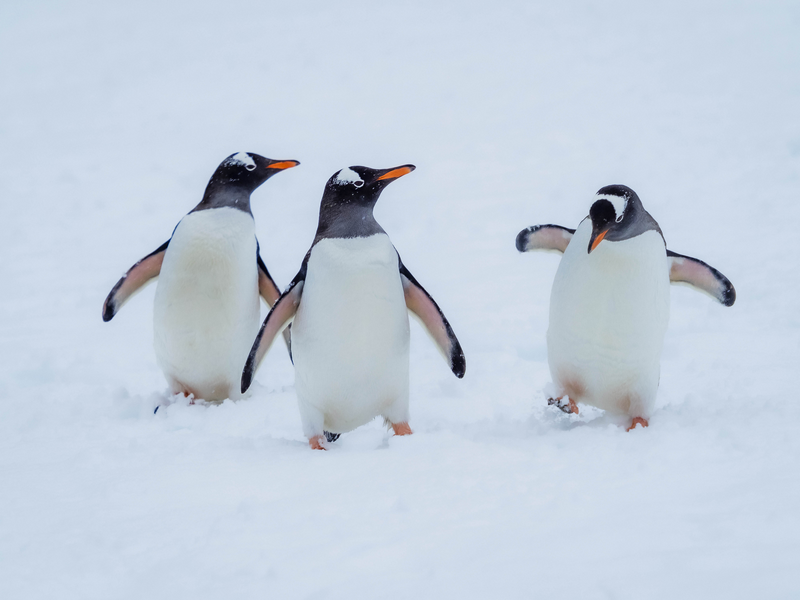
The Penguin Watch project, based at Oxford Brookes University, aims to disentangle the confounded threats impacting Southern Ocean penguins by harnessing time lapse cameras and drones to monitor remote colonies year-round since 2009. The largest regional monitoring program with over 100 field sites, Penguin Watch is building a predictive model of penguin populations as indicators of broader marine environmental health. Shaping regional policy to boost conservation, this research was instrumental in creating the South Georgia and South Sandwich Islands Marine Protected Area. National Geographic Explorer Tom Hart and his team will be joining the National Geographic Endurance in November and December 2025 for this project.
Wildlife and Ecology
Monitoring Antarctica for Sea Star Wasting Syndrome
Sea stars are top benthic predators in the Southern Ocean that play an important role in shaping Antarctica’s marine communities. Sea Star Wasting Syndrome (SSWS) is a disease with a history of outbreaks that have devastated sea star populations outside Antarctic waters but for which relatively little polar baseline data exists. Through photo imagery and tissue sampling, this project aims to document SSWS symptomatic sea stars in Antarctica to broaden understanding of both the disease and overall health of the region’s sea stars.
Wildlife and Ecology
Sentinels of the south: Tracking pathogen spread in seabirds and seals
As avian flu sweeps across the Southern Ocean, this project investigates how diseases spread among penguins, seals, and other Antarctic wildlife. By collecting and analysing guano samples during landings, the scientists will uncover hidden viruses and bacteria, helping to track movement of diseases like avian flu between species and regions. The goal is to protect vulnerable wildlife and preserve one of the planet’s last wild frontiers - while sharing this cutting-edge science with guests onboard. National Geographic Explorer Jane Younger and her team will be joining the National Geographic Endurance in January 2026 for this project.
Wildlife and Ecology
Monitoring whale health and population status to assess ecosystem change
The waters around the Antarctic Peninsula are warming significantly, impacting marine ecosystems. This project uses a suite of innovative research methods to study the health of killer, humpback, and minke whales in this rapidly changing ecosystem. The team collects aerial images using non-invasive drones to measure whale body condition; whale identification photographs are used to assess population size and trends. Monitoring how whale health changes over time allows inferences about the health of the ecosystem on which Antarctic whale populations depend. National Geographic Explorer Holly Fearnbach and her team will be joining the National Geographic Explorer in February 2026 for this project.
Citizen Science
Happywhale
Whales have unique markings on their flukes that allow scientists to identify individuals and track them across the globe. When guests capture pictures of the whales spotted on expedition, they can submit them to the Happywhale app to aid in the tracking process. National Geographic-Lindblad Expeditions ships are also outfitted with Whale ID accounts and dedicated tablets that use AI to identify the individual whales within minutes of a photo submission.
Citizen Science
iNaturalist BioBlitz
Travelers to South Georgia are invited to participate in a BioBlitz, where guests and staff join forces to photograph all the plant and animal species that they can find in a designated area during shore landings. Participant photos are then uploaded to the iNaturalist app, where they become part of the Global Biodiversity Information Facility, an open-source database used by scientists and policymakers around the world.
Citizen Science
eBird
Guests traveling on any expedition are encouraged to keep track of the birds that they spot and log their sightings on the eBird Mobile app. The app is linked to eBird, a global online database of recorded bird sightings that is available for scientific research, education and conservation.