
Here in the Antarctic, all life ultimately depends on the sea; krill and whales, seals and seabirds, even land plant communities are nourished by the productivity of the deep waters around the continent. It should come as no surprise then that the ecosystems of the Southern Ocean are both rich and tremendously varied, containing regions that are as different as the forests, prairies and deserts that are familiar to us on land.
Certain factors and processes govern this variation, some of them quite peculiar to polar environments and others familiar from places closer to home. One of the most important, in the Antarctic, is the ice itself. Sea ice and glacial icebergs are dense and massive and where they contact the bottom, the effect is devastating. Marauding bergs and grinding floes of pack ice, driven by currents and winds, plow up and erase marine communities as they pass, leaving bare rock or deep trenches gouged in the sediment in their wake. On flat and sloping bottoms there is little shelter from this ice scour and repeated disturbance allows only a hardy few creatures to survive; conversely, steep rocky walls and protected niches, sometimes immediately adjacent to heavily scoured slopes, support rich growths of less mobile and more delicate animals.
Another factor that critically influences the nature of marine communities in the Antarctic, as it does all around the world, is current. Nourishment, in the form of plankton and detritus, fills every drop of Antarctic seawater and where strong currents bathe the coasts in fresh flows of this rich soup, suspension-feeding animals like sponges, sea squirts and sea cucumbers thrive in tremendous numbers. Deep waters don’t always run still, but where they do the rain of detritus can accumulate into thick, soft sediments that provide an ideal home for burrowing clams and worms, and for the fish and sea stars that prey on them.
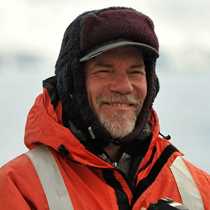
This week I had an opportunity to make an exploratory dive at a seldom-visited site in the Weddell Sea and found myself immersed in yet another physical factor that powerfully influences the makeup of polar marine communities. Even here in high southern latitudes, where the sun shines for 20 hours or more each summer day, turbidity and ice cover can shut this light out of the sea and create a world of eternal darkness, a place where some organisms cannot survive and others thrive. Not far into this dive, only about 30 feet below the surface, the darkness was near total, a condition that ordinarily prevails at much greater depths. Never one to be deterred by poor visibility, I switched on the powerful lights on my video camera and pushed on, descending through the night to 95 feet; the rewards were both fabulous and unexpected. I found myself surrounded by a menagerie of marvelous creatures that I had never encountered previously at SCUBA diving depths in the Antarctic: large feather stars, huge anemones and long-legged sea spiders, all familiar from ROV observations at 300 feet or more, were here in profusion; there was even a scale worm whose identity I can only guess at as I have never seen it before and it was over three times as long as the largest of its kind previously reported from Antarctic waters! Every dive I make in the Antarctic provides another small piece to fit into the puzzle of understanding these strange and wonderful seas; this was a very exciting one indeed.