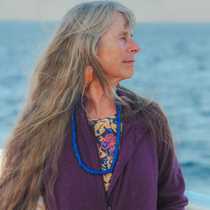
Whale Watching in Bahia Magdalena, southern transit of Hull Canal, entrance into the Pacific Ocean, heading south
As the sunrise momentarily flashed green a few minutes before 7:00AM, half of the guests and staff made ready to begin early morning whale watching. The sun slowly filled the sky shining a warm, yellow early morning glow on several Grey whales, spy hopping just off the starboard side of the Sea Lion. Several other whales also seemed to be standing on their flukes catching the incoming tide, rising to eye level, checking the latest visitors to these northern waters of Bahia Magdalena.
The northwest wind continued to blow, as all four Zodiacs dispersed in different directions. Riding the small waves, we followed the quickly disappearing blows in hopes of more intimate views of Grey whales. During the course of the morning, two whale watching adventures were offered. Several groups of adult whales were observed rolling over and around each other, raising their heads and then diving, showing off their flukes of at least fifteen feet across! Though the winds were strong, blows could be seen all around the Sea Lion and traveling Zodiacs; cow-calf pairs and adult Grey whales all enjoying the sanctuary and protection that has made the Lagoons of the western side of the Baja peninsula of Mexico so well known through out the world.
At 10:00AM, all Zodiacs were called back to the Sea Lion. It was necessary to begin our return transit of Hull Canal, catching a midday tide, which allowed enough water for the Sea Lion’s return voyage back to the southern end of Bahia Magdalena. Ahead of the ship, we could see the mountains on the southern end of Isla Magdalena. A passage called La Entrada separates the two barrier islands that encircle Bahia Magdalena. The mountains on the northern end of Isla Margarita showed their peaks as we continued our southerly journey, enjoying scenery mixed from a very unusual palate consisting of sand dunes, rocky mountainous islands, water and enormous flocks of cormorants, brown pelicans, terns and gulls. Each part of the scene meant nothing without the other, and together we saw what is beautiful about an ecosystem called the barrier islands.
At approximately 3:30PM, the Sea Lion entered the Pacific Ocean. We were immediately greeted by two new marine mammals; a cow-calf pair of humpback whales and several California sea lions doing some serious fishing. Over head gulls circled waiting for the scraps the sea lions left, while the whales continued their journey north and away from our vessel.
The Sea Lion faced a sixteen hour journey at a speed of approximately ten knots, heading for the tip of the Baja peninsula and Cabo San Lucas. We were surfing over large, widely spaced four to six foot waves. As the wind pushed us south, our day came to a close. After dinner, we returned to our cabins, enjoying a comfortable ride, while our thoughts moved on to the next half of our adventure - entering the Gulf of California and exploration of a desert by the sea.
As the sunrise momentarily flashed green a few minutes before 7:00AM, half of the guests and staff made ready to begin early morning whale watching. The sun slowly filled the sky shining a warm, yellow early morning glow on several Grey whales, spy hopping just off the starboard side of the Sea Lion. Several other whales also seemed to be standing on their flukes catching the incoming tide, rising to eye level, checking the latest visitors to these northern waters of Bahia Magdalena.
The northwest wind continued to blow, as all four Zodiacs dispersed in different directions. Riding the small waves, we followed the quickly disappearing blows in hopes of more intimate views of Grey whales. During the course of the morning, two whale watching adventures were offered. Several groups of adult whales were observed rolling over and around each other, raising their heads and then diving, showing off their flukes of at least fifteen feet across! Though the winds were strong, blows could be seen all around the Sea Lion and traveling Zodiacs; cow-calf pairs and adult Grey whales all enjoying the sanctuary and protection that has made the Lagoons of the western side of the Baja peninsula of Mexico so well known through out the world.
At 10:00AM, all Zodiacs were called back to the Sea Lion. It was necessary to begin our return transit of Hull Canal, catching a midday tide, which allowed enough water for the Sea Lion’s return voyage back to the southern end of Bahia Magdalena. Ahead of the ship, we could see the mountains on the southern end of Isla Magdalena. A passage called La Entrada separates the two barrier islands that encircle Bahia Magdalena. The mountains on the northern end of Isla Margarita showed their peaks as we continued our southerly journey, enjoying scenery mixed from a very unusual palate consisting of sand dunes, rocky mountainous islands, water and enormous flocks of cormorants, brown pelicans, terns and gulls. Each part of the scene meant nothing without the other, and together we saw what is beautiful about an ecosystem called the barrier islands.
At approximately 3:30PM, the Sea Lion entered the Pacific Ocean. We were immediately greeted by two new marine mammals; a cow-calf pair of humpback whales and several California sea lions doing some serious fishing. Over head gulls circled waiting for the scraps the sea lions left, while the whales continued their journey north and away from our vessel.
The Sea Lion faced a sixteen hour journey at a speed of approximately ten knots, heading for the tip of the Baja peninsula and Cabo San Lucas. We were surfing over large, widely spaced four to six foot waves. As the wind pushed us south, our day came to a close. After dinner, we returned to our cabins, enjoying a comfortable ride, while our thoughts moved on to the next half of our adventure - entering the Gulf of California and exploration of a desert by the sea.