12 Fascinating Dolphins to Spot on Expedition

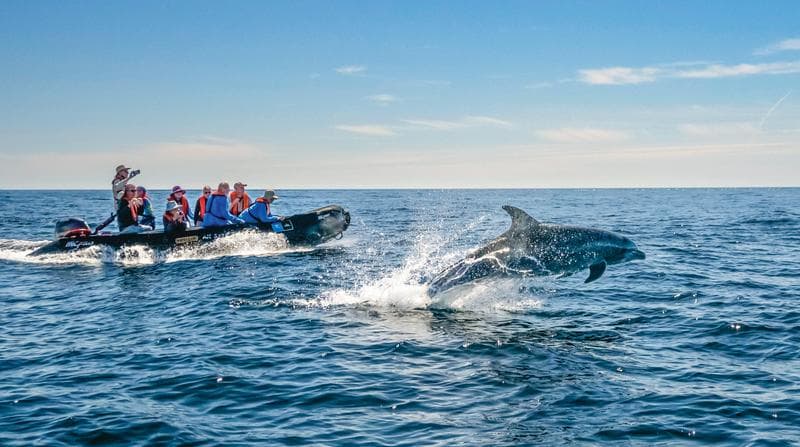
A call from the Bridge that dolphins are approaching the ship is always cause for excitement. As we grab our binoculars and head for the open decks, two questions are usually foremost in our minds: “Will they come close enough to ride our bow wave?” and “What kind of dolphins are they?” For many of us, bottlenose dolphins are by far the most familiar species–they are found all around the world and are particularly common along the Atlantic coast of the United States. But bottlenose dolphins are only one of 40 different species found all around the planet, from the Arctic to the Antarctic. On Lindblad Expeditions voyages we come across many of these beautiful animals. While it’s likely that a few of these species will already be familiar to you, there are many others on our list that might be a bit more surprising, but all of them are fascinating to see in the wild.
Main image: David M. Schrader
Spinner Dolphin
As their name implies, spinner dolphins are best known for their astounding acrobatics, leaping as high as 10 feet out of the water and spinning (barrel-roll fashion) as many as seven times before splashing down again. They are also fond of making extra-big splashes by leaping high and then twisting to land on their sides. Spinner dolphins are found in tropical waters all around the world, but we often spot them playing in the strong currents at the entrances of Polynesian atolls.

Pantropical Spotted Dolphin
You can probably guess that pantropical spotted dolphins are found in tropical waters all around the world, from the Indian Ocean to California and from Brazil to Africa. Many species of dolphins share this broad range, and it is thought that they evolved before the rise of the Isthmus of Panama divided the Atlantic from the Pacific. Like their relatives the spinner dolphins, these spotted dolphins were terribly impacted by tuna fisheries in the mid-20th century, but thankfully their population is recovering well today.

Orca
Orca or killer whales, as they are also known, aren’t really whales at all. These incredibly powerful animals are actually the largest members of the dolphin family; adult males can reach up to 30 feet and weigh up to 10 tons. Orca are also among the most social and intelligent of all marine mammals, hunting cooperatively and teaching elaborate behaviors to their calves.
Photo: Ralph Lee Hopkins

Short-Finned Pilot Whale
Pilot whales (the short-finned species and its close relative, the long-finned, which are indistinguishable at sea) are among the most social of all dolphins. They live in matrilineal groups, led by the oldest females, just as orca do. Unlike most mammals—other than humans and orca—the females live long past their reproductive years and remain vital members of their community, caring for the young and teaching them valuable lessons, passing on the culture of the group.
Photo: Ralph Lee Hopkins

Risso's Dolphin
Dolphins are typically characterized as friendly and gentle creatures, but that’s not always the case. Some of them, like the Risso’s dolphin, can be pretty rough and tough. This big, powerful species is almost always covered with many crisscrossing white scars from competition during mating as well as from run-ins with squid, its preferred prey. Risso’s dolphins use an amazing dive technique that allows them to spin rapidly like a corkscrew to depths of over 2000 feet, where they feed on huge schools of squid.

Hourglass Dolphin
The southernmost species of dolphin, hourglass dolphins are found all around the Antarctic, from cold temperate waters all the way down to the edge of the pack ice in the Southern Ocean. Their name refers to the distinctive markings on their sides that resemble a narrow white hourglass on a black background. During our voyages to Antarctica, we can observe this striking species who particularly enjoys riding the ship’s bow wave.
Photo: Ralph Lee Hopkins

White-Sided Dolphin
On the other end of the world, we can find one of the hourglass dolphin’s closest relatives, the Pacific white-sided dolphin. They are one of the few species that occur very far north in the Pacific, so we keep an eye out for them on our expeditions to Alaska. Pacific white-sided dolphin is quite a mouthful, so we usually call them ‘Lags,’ which is short for the name of their genus, Lagenorhynchus, the same as their cousins in the Antarctic.
Photo: Jeff Mauritzen

Commerson’s Dolphin
While many dolphins are sleek, fast, and very beautiful, Commerson’s dolphins are really just super cute. They are small (only about five feet long) and stocky, with black and white markings that make them look something like swimming pandas. They love to ride the surf and while diving in the Falkland Islands I have had large groups of Commersons come over to play, zipping by and tumbling through the water around me like a rambunctious litter of puppies!
Photo: Justin Hofman

Hector’s Dolphin
These lovely little dolphins are the smallest and rarest dolphins in the world, endemic to the coastal waters of New Zealand. Hector’s dolphins are severely threatened by fishing, boat strikes, and coastal pollution and they are one of the few dolphins listed as an endangered species. Their three very close relatives—Commerson’s dolphin and Chilean dolphin in South America and Heaviside’s dolphin in Namibia—are thought to have only recently been separated by the powerful currents that circle Antarctica.
Photo: Michael S. Nolan

Southern Right Whale Dolphin
This might be a little confusing, so let’s be clear: these sleek, elegant animals are members of the dolphin family. Their name comes from the fact that unlike the great majority of dolphins, they have no dorsal fin, a trait they share with Right Whales. They are quite slender, with distinctly tapering bodies and clean, sharply divided black and white markings, which leads many people (like me) to believe that they are the most beautiful of all marine mammals.

Amazon River Dolphin
Amazon River dolphins are the exception on this list, because they are not technically in the dolphin family, but we had to include them because they are so remarkable. For one thing, they are pink. It’s quite amazing to see a pink dolphin lift its head out of the dark green waters of the legendary Amazon. They have very long snouts and unusual teeth, an adaptation that helps them to eat the extremely varied diet available in their river habitat.

Australian Snubfin Dolphin
These small, stubby dolphins are not the most elegant of the family—they could be called snubnose as well as snubfin. On the other hand, they have the honor of being the closest living relative of the orca, Australian snubfin dolphins are a very recently recognized species, found only in northern Australia and likely in New Guinea. They are fairly rare, so it’s fun to keep an eye out for them in the beautiful, sheltered bays of the Kimberley region.