With the swells of the Scotia Sea rolling behind us, we have made excellent time on our crossing from Elephant Island. This morning, as patches of blue sky and snow squalls came and went, we began our final preparations for landfall at South Georgia. It’s not far away now, and we are all very eager to see this famous island come into view ahead of our ship.
After breakfast we gathered in the lounge to hear a presentation on the administration and conservation of South Georgia, and the rules and regulations for our visit there. Then it was time for another round of decontaminating our gear, particularly the boots we used for tromping around in the penguin guano at the Antarctic Peninsula. Ecologically South Georgia is a unique gem, deserving of the very best protection we can give it, so we were all careful to prepare properly for our visit there.
It wasn’t long though, before our attention turned outside, well before the island itself was visible. Lisa, our expedition leader, alerted us that we were approaching a tremendous iceberg known as B17A. This was a seriously large piece of ice, approximately seven miles square, making it roughly the size of the city of San Francisco! It had broken off the Ross Ice Shelf in late 1999 and drifted for 16 years under the influence of the polar easterlies, circling three-quarters of the continent before it was caught in the Weddell Sea gyre and carried to the north were we encountered it, grounded on the shallow banks off South Georgia.
From our perspective, beside it on the sea, the berg appeared as an endless wall of ice, stretching to the horizon in both directions. Wandering albatross soared over its ramparts and thousands of Antarctic prions swooped and dove and rested on the water nearby, feeding on the blooms of plankton that were nourished by the mineral-rich currents upwelling along the sides of the berg. Just as we were departing, a group of hourglass dolphins appeared for a few moments, treating us to a brief look at one of the most beautiful marine mammals in the world.
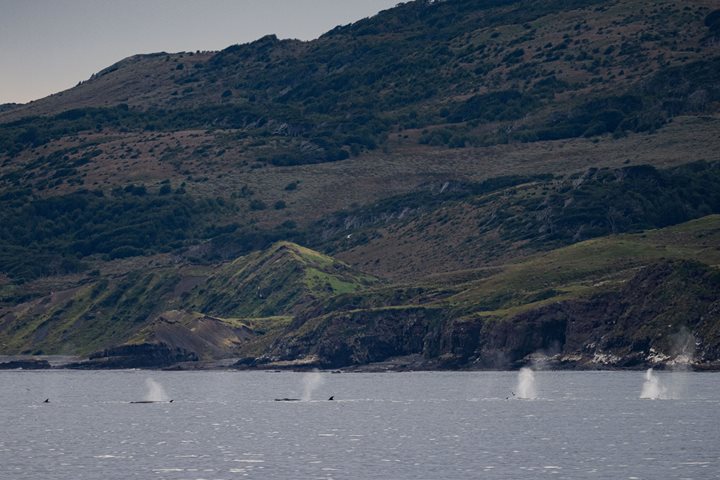
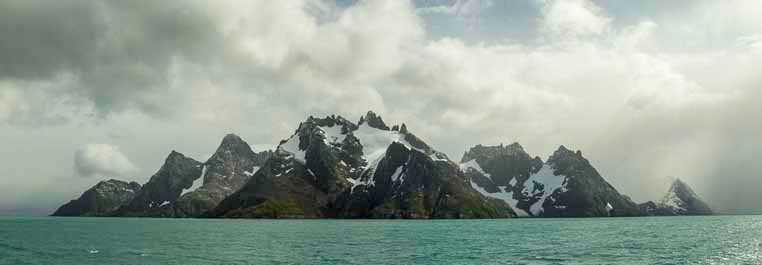
Then, at last, the island itself! Under dramatic skies where wind-torn shreds of cloud seemed to glow in fleeting beams of sunlight, the mountains of South Georgia came into view. Impossibly craggy, their ridges toothed with needle-like pinnacles, dusted with new snow, they were even more spectacular than we had imagined they might be. It wasn’t long before Captain Kreusse brought National Geographic Explorer close under the cliffs and we entered the dramatic channel of Drygalski Fjord. At first the walls of this long glacier-cut waterway, which leads deep into the mountains at the south end of the island, were almost hidden in blowing snow and drifting clouds, but we made our way further and further in, finally arriving at the face of the Risting Glacier, a broken blue wall of ice tumbling down to the sea between the dark walls at the head of the fjord. More upwelling currents here meant more wildlife and we were all out on the decks, soaking in the scenery and working on technique for photographing the thousands of birds and seals that make this spectacular place their home.
South Georgia! We’re here! We want more!