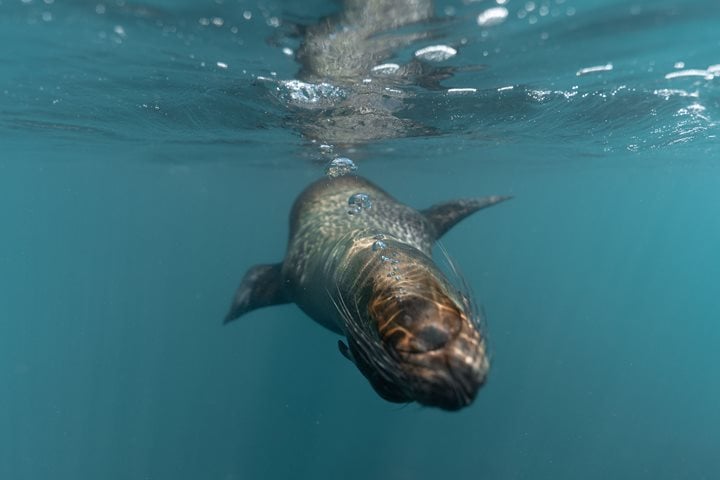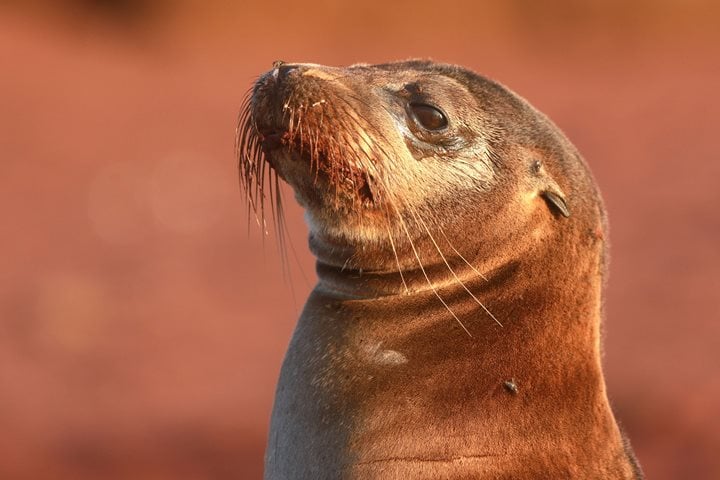

The oldest island of the archipelago, Española, is small, flat, and dry, but with exuberant life like nowhere else in the Galapagos. Of course, from the point of view of a geologist this island is dying, but it contradicts the fact that there is an explosion of life found here. This day is highly anticipated as we awaken at Gardner Bay at Española Island. A bright white coralline beach in the distance is littered with Galapagos sea lions and some mockingbirds. We proceed to a small islet to snorkel in the deeper water while some visit the beach. The abundance of tropical and temperate species is found mingling with razor surgeonfish, snappers, endemic black-stripped Salemas, and creole fish. A sea lion flits by with an intention to investigate these strange floating creatures it finds. We observe a reef shark passing under us and we see its elegance as it heads to deeper water. In the shallows, our guests hop in and out of the water with young sea lion pups following suit and we wonder who is playing with whom. Espanola mocking birds decide to rifle through our equipment that we have left on the beach. A few mocking birds from different “clans” decide to fight over territory, with wings and tail feathers bobbing up and down in their displays. At a distance, dry vegetation and some green bushes produce a colorful landscape, while in the sky frigate birds and blue footed boobies float like kites.
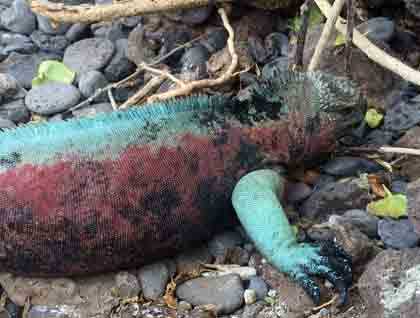
After we visit Gardner Bay and after a short navigation, we arrive at Suarez Point on the southwestern part of the island where we explore an incredibly dense habitat, which means that we have to step over the wildlife at times. Large waves pound the coast and curve around the point close to our landing site. The exposed, rounded basalt boulders are covered in areas by some brightly colored marine iguanas. Upon the path we find both aspects of life and death, with Espanola lava lizards feeding on the various insects and utilizing the carcass of a large sea lion for their necessities. Mesquite and salt brush surround us as we head towards the southern cliffs. Nazca boobies find this a perfect place for roosting and nesting, as it is proper platform for heading out to the open ocean. A mist rises above the southern cliff, which is caused by large waves being compressed into a natural fault that is found in the basalt lava flow. Galapagos hawks find elevated positions on the boulders that are our path. Some hawks even eye us with interest as they look for prey. We were very happy to see two waved albatrosses flying in the distance, probably the last two after migrating to the southern region of South America, where they spend many weeks after returning to Galapagos where the temperature decreases and weather conditions change. They are endemic not only to Galapagos, but also to this specific island and we find beauty in this continuation of life. With the last beam of sun, tired but very happy, we returned to the National Geographic Islander, observing a beautiful sunset with the best memories of this incredible day in the Galapagos.