Today, we enjoyed exploring Floreana Island, a unique place in the Galapagos Islands where human and natural history combines in a fascinating way. Early in the morning, we visited Punta Cormorant, named after HMS Cormorant, an English vessel which navigated around South America at the end of the 19th century. We landed our Zodiacs on the beach of the island, where we were welcomed by approximately 60 Galapagos flamingos. These gregarious birds, which reside in salt water lagoons such as this, enchanted our guests with their brilliant pink coloration. For the great majority of our guests, this was their first encounter with flamingos in the wild! What an amazing start to our excursion, and our experience just got better as we continued our walk on the fine sandy beach, where we spotted a Galapagos penguin swimming across the waves. This was a great chance to reflect on the uniqueness of the Galapagos as an archipelago, where you can see tropical birds, like flamingos, as well as birds that are typically from the coldest regions, such as penguins.
After breakfast, we visited Champion Islet, where we searched for the Floreana mockingbird. This endangered bird is very important to science and conservation, as it is one of the four species of mockingbirds which inspired Charles Darwin’s theory of speciation under natural selection. Unfortunately, the population of this bird is now mostly extinct in Floreana due to introduced species, with only two small populations surviving on two satellite islets, one of them being Champion. We learned about the important efforts of local and international organizations, including the Lindblad National Geographic Fund, to find ways of returning these birds their original island, Floreana. With all this in mind, we were all thrilled when we spotted two of this elusive birds standing proud on top of an opuntia cactus.
This week has been very special, because we have a team of professional photographers from National Geographic onboard for this voyage, who are sharing their knowledge and skills with our guests. As part of our unique schedule this week, after lunch we enjoyed a lecture on photography techniques which all of our photographer guests enjoyed.
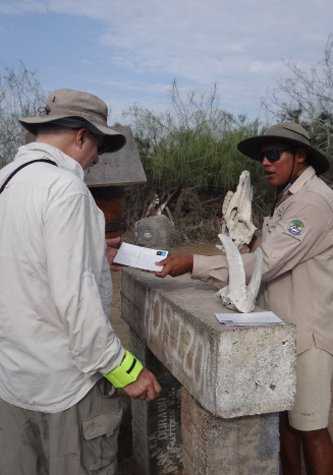
During the afternoon, we explored the coasts of Floreana Island by Zodiac. It was an incredible afternoon, and we watched playful sea lions and plunging blue-footed boobies against the beautiful green scenario of mangroves and cacti. We also spotted an eagle ray and several sea turtles. To finish the day, our guests visited Post Office Bay. In this historical site, we learned that the history of the Galapagos is strongly connected with the world’s history. The Galapagos archipelago was one of the main whaling spots in the world until a whaling base was established in Japan in 1819. In this context, whalers from different parts of the world used to deposit letters into a wooden barrio, hoping that the next visiting whaler could hand deliver their correspondence. Nowadays, visitors to the islands have a different purpose than whalers had, but the tradition has remained, and now it give us the opportunity to connect the different visitors of the Galapagos, by depositing letters which later will be hand delivered by next visitors. As this day comes to a close, our guests are fascinated by the unique biodiversity and human history of the Galapagos. Tomorrow will undoubtedly be another exciting day, as we make our way to Santa Cruz Island.