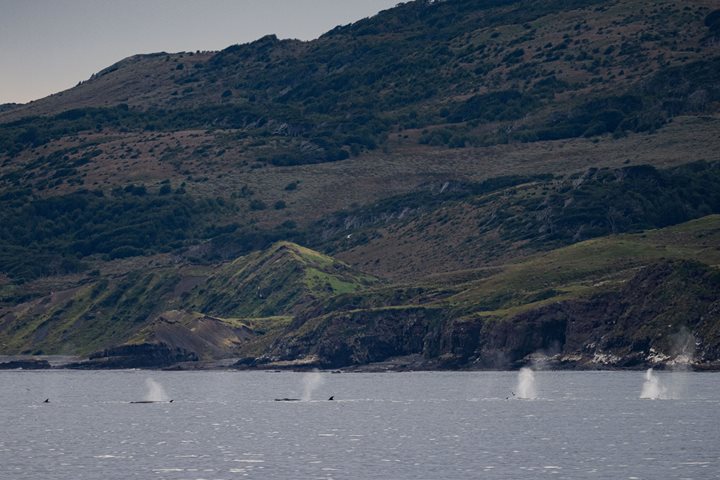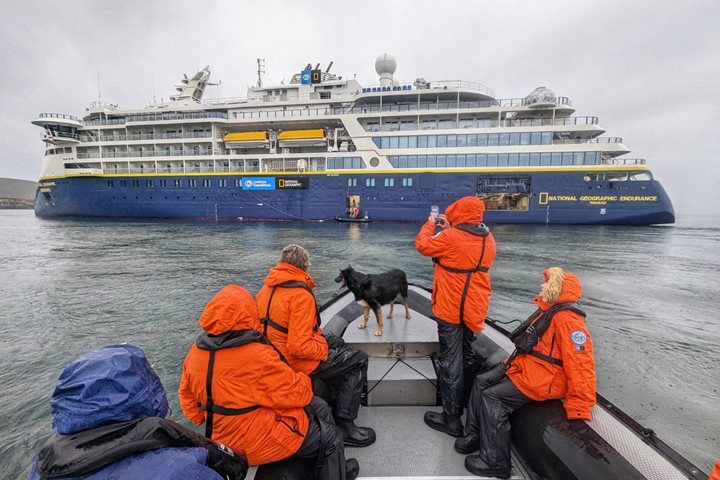

During breakfast, National Geographic Orion made her way deep inside Prince Olav Harbour. This very narrow and scenic bay is located on the western shore of Possession Bay, where Captain James Cook claimed the land on behalf of his king, George III. In fact, Cook’s description of the landing site chosen for the ceremony sounds very much like this very site. At the time, Cook thought he had finally discovered the great Terra Australis Incognita (the Unknown Southern Continent), but soon realized the new land was simply a large island.
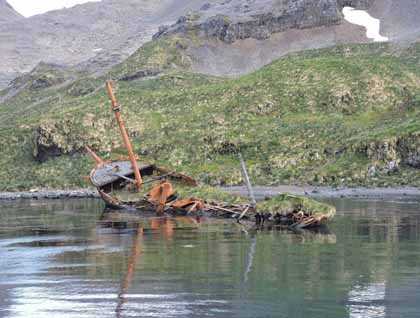
In 1911, a whaling station was set up here, but for the first few years all the processing of whale carcasses took place on a steam-powered factory ship called Restitution that was moored in the bay each summer. This lasted until she was wrecked in the Isles of Scilly off Cornwall, England, in 1916. After that, a slipway was constructed and all whale processing took place on land, similar to what we saw at Grytviken a couple days ago. An old three-masted bark called Brutus (built in Glasgow in 1883) was purchased for use as a coaling ship after she was retired from the South American nitrate trade. She remains there today as a wrecked hulk near the ruins of the whaling station.
Many of us went ashore right after breakfast and enjoyed the rest of the morning hiking about in the surrounding hills. Others opted to spend their time kayaking in the windless conditions and glass-calm waters. Kelp abounds in this bay, so the kayakers had to be careful to not get trapped in the floating mats. Just above the landing beach, we discovered a beautiful little lake up on the tussac-covered plateau that was being enjoyed by many young fur seals (no surprise there) and South Georgia pintails. One annoying little fur seal kept chasing the ducks, but they just kept swimming away from him even though they could easily have come out of the water onto the grassy slope. They really didn’t seem to mind him too much, as it was simply a game to him. It seems everything is simply a game to young fur seals. Other hikers went for a longer, harder trek high up onto the steep hillside above the whaling station. When everyone was back aboard the vessel, Captain Martin took the ship farther into the bay for a close look at the whaling station before we continued on our way to the final destination of our South Georgia experience.
By mid-afternoon, we arrived inside Elsehul Bay, which is located near the western end of the island. This bay contains the largest Antarctic fur seal colony in the world and is home to nearly all the species of breeding birds found in South Georgia. Captain Cook described the island as dreary and uninviting, but he did mention the myriad fur seals they encountered at the landing in Possession Bay and had seen in the surrounding waters. Within 10 years, sealers began arriving at South Georgia, and the main center for taking fur seals was Elsehul Bay. This was a huge money-making bonanza that was sort of free for the taking (apart from operating costs) and many fortunes were made. The pelts were prized for the dense woolly underfur, which was used to produce felt, which was then turned into hats, coats, drawer liners, etc. Over a period of less than 40 years of unrelenting sealing, the fur seals were virtually extirpated from South Georgia. However, they have made a spectacular comeback!
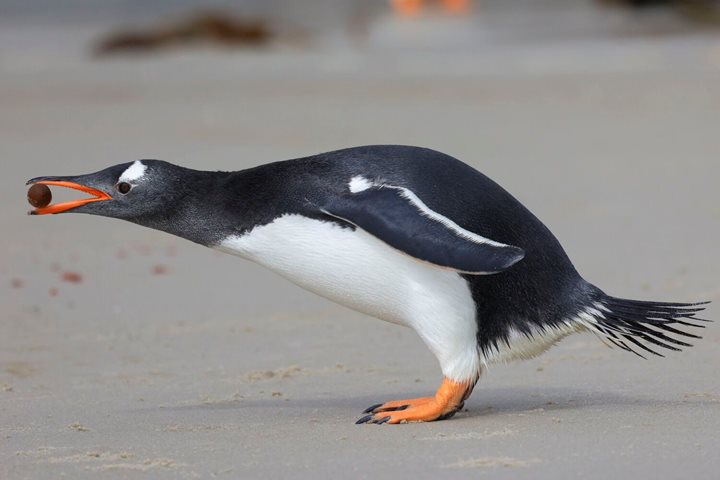
Some of us went ashore near the head of the inner bay for more hiking and climbing, while others enjoyed Zodiac cruises in both the inner and outer bays. The shore people found three 19th century trypots that had been left here from the days of sealers who came to get oil from elephant seals. It is hard for us today to understand the mentality of the heartless killing of millions of wild creatures that came here to breed, but it was a different time and the world demanded oil and natural furs. In the modern age, fossil fuels, commercial plant oils, and synthetic fibers have saved the whales and seals. Elsehul Bay is home to impressive breeding colonies of black-browed albatrosses and grey-headed albatrosses, and numerous pairs of light-mantled albatrosses were also seen. In addition, a huge colony of macaroni penguins was sighted on the eastern hillside. Those of us who went ashore found king penguins and gentoo penguins. It was very heartening to see numerous South Georgia pipits at both sites we visited today, because both sites had long been infested with rats that were introduced by the early sealers and whalers. Since the successful rat eradication programs of the past three years, this tiny bird (the only songbird in the Antarctic environment) has made an impressive and dramatic resurgence from near extinction. Pipit, hooray!