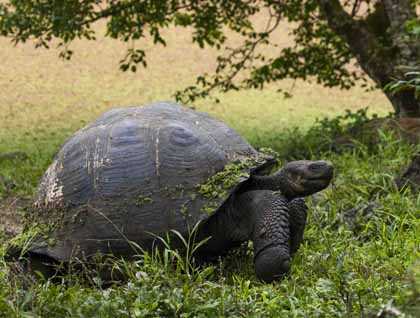
Evolution is very easy to understand when it is right in front of our eyes. Today, at the Charles Darwin Research Station, we had the chance to see the giant tortoises from Española Island. As we have seen, Española, the oldest island in the archipelago, is a small, and most importantly, flat island. It does not reach the clouds, and therefore very little precipitation falls. Grass rarely grows, so tortoises there have spent millions of years reaching up to feed on cacti and bushes. Siblings are always slightly different, and the same goes for tortoises. The ones who were born with slightly longer necks, and a shell that enabled them to reach up slightly higher were naturally able to survive better, and therefore pass on their genes. After millions of years, we can see their “saddleback” shaped shell, which has evolved due to the process of natural selection.
During the afternoon, we also got to explore the grassy highlands of Santa Cruz, and see dozens of tortoises in the wild. Santa Cruz is a large and tall island, and therefore catches much more precipitation. This brings grasses and dense ground vegetation. Understandably, the tortoises on this island haven’t needed to reach for their food, but are simply able to nibble the tender shoots right in front of their feet. This place is lush, and thick with vegetation, so moving around here requires a shell that doesn’t catch extra branches. A saddleback shell would work terribly in this mess of flora. Instead, natural selection has evolved a “dome shell,” which is curved down in the front to enable tortoises to plow through the forest like little tanks. Isn’t evolution simply marvelous! It is basically the pursuit of perfection.
Coming to Galápagos is life changing, and this laboratory of evolution has helped us discover perhaps the greatest revelation to connect our species of bipedal primates to the rest of the tree of life. Yes, we share 98.4% of our DNA with Chimpanzees. To paraphrase Joe Rogan, “if I gave you a sandwich that was 98% dirt, and 2% ham, would you be willing to call that a ham sandwich?”
We also share 50% of our DNA with bananas, and there’s something wonderful about that fact. It helps illustrate the fact that plants and animals diverged about 1.5 billion years ago. Learning the truth of evolution brings a new comprehension, and appreciation for our lives at home. We can look into the eyes of our dog, see a chain of ancestry back to wolves, and appreciate the fact that evolution created a great companion. Nothing is as inspiring, and connecting, as the facts of science.
Dedicated to Charles Darwin.


.jpg?width=106&height=85&mode=crop&scale=both&quality=50)