
As the morning wakeup call echoed through the ship we sailed into Fortuna Bay to drop the eager hikers who would do the final part of the horrendous march that Shackleton, Worsley, and Crean did from King Hakon Harbour to their safe heaven, Stromness whaling station in mid May 1916. A hundred years ago they reached the rim and looked down the valley leading to Stromness, suddenly hearing the steam whistle call all hands to their work stations. They now knew safety was near, after an almost indescribable Antarctic hardship since October 1915 and the ship Endurance sank. When they reached the manager’s villa they were able to enjoy a cleanup with hot water, get new cloths, and dump their things they had been wearing since the ship sank. Add also a good meal sitting by table and later sleep in a real bed. Most likely a surreal experience for these three men.
As we saw the backs of our Shackleton re-enactors disappear up on the slopes in Fortuna Bay, the ship moved around to the whaling station Stromness, to later recover our troops at their final destination but also offer those not wanting to do the hike, the possibility to at least retrace the bit from the famous waterfall Shackleton, Worsley, and Crean slid down and through the valley down to Stromness.
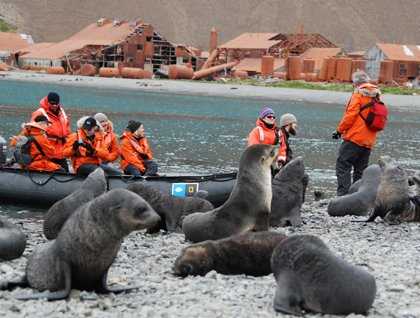
A visit in late February and early March to South Georgia will always be remembered for the sheer number of fur seal pups. The population nowadays is estimated in the several millions. Those staying near the beach at Stromness enjoyed playful fur seals pups in groups of maybe hundreds practicing their swimming abilities. It is hard not to be touched and drawn to these cute little seal pups. Although very ‘cute’ at this stage, from the first day born they have an instinct to bark and bite. The flatland behind the whaling station was literally filled with seal pups and also some nursing females as they do this for almost four months.
Stromness whaling station is today a ghost town and wear and tear from the strong winds, often with hurricane forces, have slowly ripped away bits and pieces. Although the station manager’s villa is still standing, which is where the Endurance men enjoyed when returning to civilization.
During lunch the ship repositioned into Cumberland West and soon after keen hikers were ashore at Maivik. The location was named and used by the Swedish Antarctic expedition in 1902 and they established a shore party here May 1st. The cartographer Duse was to describe and map the area and his name still last here for the peak Mt. Duse. As the hikers slowly made it towards Grytviken, the same route Duse did in 1902, and named the location after the sealers tripods he found (gryta = pot, vik = bay). The ship went around Mt. Duse and into the bay and soon after we had made the formal clearance everybody went ashore to explorer the museum and the whaling station.
Of course now that we have our own full Shackleton story, starting with an ice walk far south on the peninsula with barbeque, retracing the path from Elephant Island to the magic South Georgia, 16 days with the boat James Caird but only 2 days for us in great comfort, and finally the last part of the crossing of the island, it was time to visit Shackleton’s and Frank Wild’s graves to toast these amazing men to withstand hardships almost impossible for us to imagine.
As dinner was approaching several of the BAS staff (British Antarctic Survey) at King Edward Point came onboard to present several of the projects they are running here at South Georgia. A major focus was on the rat eradication program they have worked on since 2011, the largest island anywhere in the world to try out. Yesterday we sighted the South Georgia Pipit, the only song bird to live south of the Antarctic convergence, at both Hercules Bay and at Godthul, a good sign of success to eradicate the rats. Before, this little discrete bird only survived on a few rat free outlaying islands. We also learnt about the success with the fisheries around South Georgia, heavily controlled and tightly managed.
A long day finished with good dinner together with the “BAS people’ and soon after directly to your ‘bunk’ to catch a few hours’ sleep, as our expedition leader promised a very early wake up call for a sunrise landing at the 2nd largest king penguin colony.
.jpg?width=106&height=85&mode=crop&scale=both&quality=50)