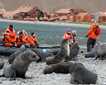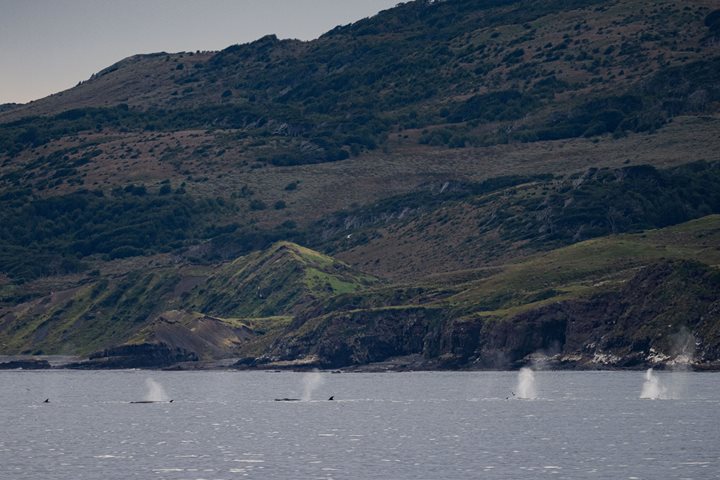
Maybe it’s the fact that February 29th doesn’t happen that often but today felt like a bonus. Something extra. Blue skies with a rainbow, whales and calm seas, chocolate sauce on ice cream. Maybe this is just how every day in South Georgia feels, to wake up with the grandiose mountains rising up right from sea level knowing that this place is truly special. This land is teeming with life, countless multitudes of birds, seething masses of fur seals and grasses so green they seem to glow. The latter may have something to do with the fact that the terrestrial color spectrum of the Antarctic Peninsula rarely departs from black, brown, grey and white and our eyes are still adjusting to the photosynthesizing pigmentation of the vascular plants that cover the slopes.
While this environment looks so idyllically pristine it must be noted that it has been heavily altered and impacted by humans. Not so long ago there were thousands of reindeer that had flourished in numbers in ways only an introduced species can. Even in their absence, a few antler and bones being the only clues left, the spread of certain grasses has changed the landscape to a degree. Similarly, rats, apparently eradicated entirely, devastated the nesting bird populations on the main island. But, their removal allows for the return of the displaced species.
This avian resurgence had been thought to be an unobtainable goal, however the environment itself aided significantly. Glacial valleys segment the island into impassable sections, isolating rat populations, but more important are the smattering of small islands lying just offshore. Visiting Prion Island, with its frigid ocean moat defense, it held the rodent invasion at bay and provided a sanctuary for vulnerable species like the wandering albatross and the mighty pipit, the only Antarctic songbird. These unspoiled havens now can repopulate and reclaim South Georgia and as amazing as it is now, in another four years it will have something a little extra.