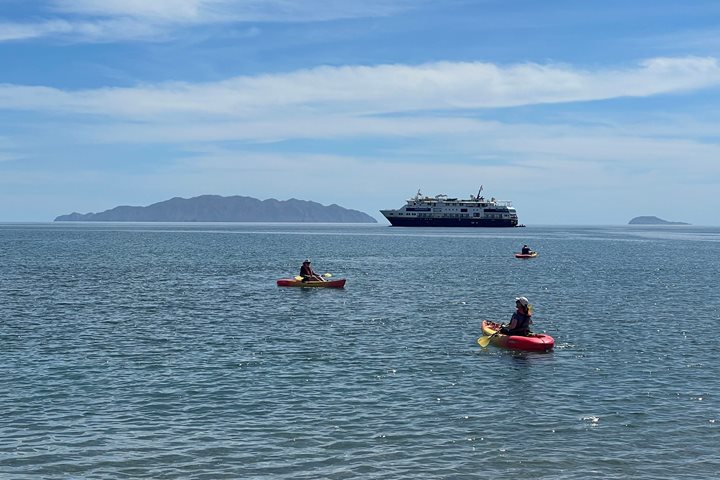
The first morning of a new month began, as per our usual, sipping coffee and swapping yarns on the foredeck of National Geographic Sea Bird. We were headed south, toward the end of the Baja California Peninsula. Venus faded in the eastern sky as a red glow gradually overcame the night and the sun rose above the horizon. We crossed the Tropic of Cancer on our way to our morning destination of Gorda Bank, an area of shallow water where humpback whales gather each winter. We marveled at schools of fish roiling the surface water of the ocean. We scanned the horizon looking for blows ... and we found them.
Each winter humpback whales come to Gorda Bank, their bodies now recharged with stored energy in the form of blubber after a summer spent feeding in the ocean off the Pacific Northwest. Pregnant females come here to give birth and nurse their new calves in relatively warm water. Adult males, and females that have weaned their previous young, come to court and mate. In these humpback whales the north is for feeding, the south is for breeding. We watched a group of five of these behemoths, which we took to be a female being actively pursued by four amorous suitors, oblivious to our presence. I was once again struck by the challenge of interpreting whale behavior from the brief moments when they come to the surface to breath. Just what are they doing, how are they interacting when they are below the surface, obscured from our eyes?
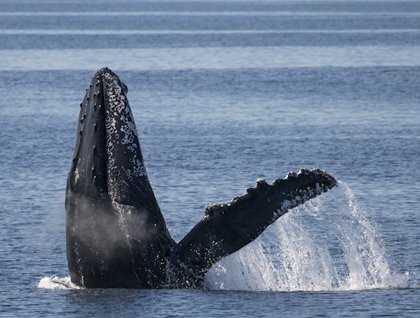
Humpback whales are the most acrobatic of the great whales, and some of them put on a great show, rolling to slap their enormously long pectoral fins on the water, and leaping from the water in a full-body breach, followed by the mighty splash of a 40-ton whale. What is the meaning of such behavior? Does it, somehow, relate to our presence? Do they do it to impress other whales? We can only speculate, and so we did.
For the afternoon, our ship docked in the marina at San Jose del Cabo and we disembarked (without getting our feet wet!) and boarded coaches for a visit to the old mission town. It is now the site of a lively tourism industry, rather more stately than its more raucous neighbor of Cabo San Lucas. Some visited a glass-blowing factory and wandered among the shops that line the main street. Others went seeking birds that make use of the estero that brings freshwater down from the mountains of the Sierra de la Laguna. Freshwater is a rare commodity in the deserts of Baja California, and we found a great diversity of birds taking advantage of it. Many of them are migrants making a fueling stop on their way to breeding grounds in the north.
We returned to the ship and departed San Jose del Cabo for one more activity in this full day: a drive-by the famous pink granite arch of Land’s End, at the tip of the Baja California Peninsula. By 6:22 we had assembled on the bow. At 6:23 our binoculars were directed toward the western horizon. At 6:24 we swung our binoculars to watch the last of the solar disk drop below that horizon and we (or, at least, many of us) saw (or we claimed to see) the brief bit of color that is the famous "green flash"—not a flash at all but, really, a blip of color atop an orange disk. Then we rounded the Cape, "battened down the hatches," and turned to the north for our trip up the Pacific Coast to Magdalena Bay and the adventures that await us there.