The 25 Best Expedition Photos of 2025

Exploration reveals itself in moments both ordinary and extraordinary. Across polar seas, tropical archipelagos and ancient landscapes, our naturalists, undersea specialists and certified photo instructors captured instances when timing, light and presence aligned. From penguins darting through Antarctic waters to a centuries-old tradition unfolding in Turkey, these images reflect the depth and diversity of travel at the edges of the map. These are the 25 best photos of 2025.
A Narrow Passage | Greece
Photo: Andrew Peacock
National Geographic Orion navigates the Mediterranean's Corinth Canal, where sheer limestone walls rise steeply on both sides of the ship. Cutting across the Isthmus of Corinth, the canal links the Aegean and Ionian seas, sparing vessels a long journey around the Peloponnese—but only ships that are compact enough can make the passage. Seen from above, the image captures a rare transit: an expedition vessel small enough to thread this historic waterway, following a route sailors have used for more than a century.
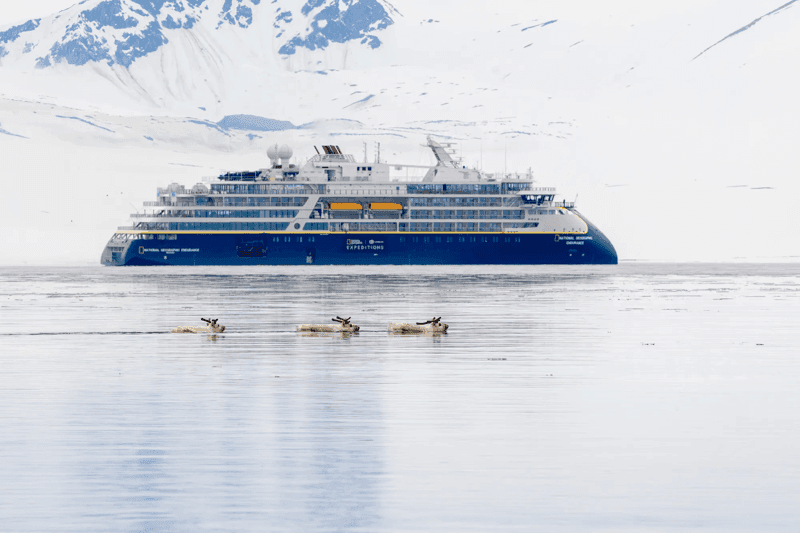
The Scale of the Arctic | Svalbard
Photo: James Hyde
National Geographic Endurance sits offshore beneath snow-covered mountains while a small group of reindeer moves through the shallow coastal water in the foreground. The photo’s composition emphasizes scale—from the ship’s broad profile to the quiet presence of wildlife—set within the stark, open Arctic environment.
Island Adaptations | Galápagos
Photo: Dennis Ballesteros
A marine iguana rests on a sun-warmed rock, its rough scales and muted spines edged with hints of green, rust and black. Found only in the Galápagos, these reptiles are the world’s only sea-going lizards, feeding on marine algae and relying on basking to regulate body temperature after cold dives. This close-up highlights the textures, colors and physical adaptations that allow marine iguanas to thrive in one of the planet’s most distinctive island ecosystems.
Cathedrals of Ice | Antarctica
Photo: Andrew Peacock
Zodiac cruising among icebergs is a highlight of our voyages in Antarctica. From water level, guests pass beneath towering slabs of ice, tracing deep blue bands formed by centuries of snowfall compressed into glacial ice. Expedition leaders help interpret the shapes and textures—explaining how wind, currents and recent calving events shape each iceberg differently. The experience is both exhilarating and grounding: engines idle, cameras click and the sheer scale of the ice makes every encounter feel unforgettable.
Front-Row Breach | Alaska
Photo: Jessie Johnson
From the bow of National Geographic Quest in Alaska, guests watch as a humpback whale rises vertically from the water, its massive body suspended against the still surface of the fjord. Cameras lift across the deck as travelers lean forward, tracking the movement together. Moments like this often unfold without warning, turning quiet observation into collective excitement.
On Deck Aboard National Geographic Endurance | Canadian Arctic
Photo: Sue Forbes
Between landings in the Canadian Arctic, guests gather on deck aboard National Geographic Endurance, watching the landscape slide past. Snow-dusted peaks rise close to the waterline, reflected in the ship’s curved glass as travelers pause to photograph and observe what lies ahead. These in-between moments—unstructured and unhurried—are often when the scale of the Arctic feels all-encompassing, framed by the ship itself and the wilderness beyond.
Traces of the Past | Greece
Photo: Lisa Hornak
Headless marble figures stand among low stone walls, their draped forms softened by centuries of weathering. Though faces and limbs have been lost to time, the careful carving of fabric and posture remains, offering insight into the craftsmanship of the ancient world. The photograph draws attention to what endures—texture, proportion and material—preserved in place long after the figures themselves were completed.
Paddling Amid the Mangroves | Costa Rica
Photo: Carlos Calvo
A line of kayaks threads through Costa Rica’s mangrove channels, moving with the gentle curves of the waterway. Guided paddling excursions offer guests a different perspective on the rainforest—a chance to glide beneath dense green canopies where tangled roots shape the shoreline and the ecosystem’s inhabitants come into view. The experience is calm and immersive—an opportunity to explore at water level, where the pace slows and the details come into focus.
Cold Water Drifter | Iceland
Photo: Kim Nesbitt
Just below the ocean’s surface, a moon jelly drifts through cold green seas, its translucent bell revealing four delicate, clover-shaped rings. Common in northern waters, moon jellies move with gentle pulses, carried as much by currents as by their own motion. Captured on an Iceland expedition by Undersea Specialist Kim Nesbitt, the image offers a quiet glimpse beneath the waves, where light and temperature shape life in subtle ways.
A Closer Look | Galápagos
Photo: Adrian Vasquez
With one bright blue eye peering out from beneath layered feathers, a booby pauses mid-preen. These seabirds spend much of their time maintaining plumage, using their bills to align feathers for insulation and waterproofing—essential adaptations for life spent diving and resting at sea. This striking image captures texture, color and detail that reveal the fine structure behind a bird built for flight and fishing.
Hidden in Plain Sight | Amazon
Photo: Ramiro Adrian
Just the eyes and ridged brow of a caiman break the surface of the Pacaya River, nearly indistinguishable from the surrounding reflections. In the flooded forests of the Peruvian Amazon, these reptiles often remain motionless, relying on their camouflage in places where water and vegetation blur together. The photograph captures the still tension of the moment, where presence is revealed by only the smallest details.
Skimming the Surface | Baja California
Photo: Carlos Navarro
A cormorant skims just above the water’s surface in Baja California, wings extended in a steady, powerful glide. Built for both flight and diving, these seabirds often travel low, using ground effect to conserve energy as they move between feeding areas. The photograph freezes a precise moment of balance and motion, highlighting the streamlined shape and feather detail that make cormorants such efficient coastal hunters.
Beneath the Surface | Antarctica
Photo: Andrew Peacock
From the deck of an expedition ship, Antarctica can feel calm and expansive—but just beneath the surface, life moves fast. A penguin rockets through icy water, using powerful flippers to “fly” below the waves while the expedition ship waits above. Guests often spot these sudden bursts of motion during Zodiac cruises or while scanning the sea from deck level, where moments like this unfold in an instant. The contrast is striking: stillness above, speed below—one of Antarctica’s many reminders that the action can sometimes happen where you least expect it.
Aurora Over Northern Waters | Canada
Photo: Bryan Holliday
The northern lights unfurl across the night sky above Canadian waters, casting bands of green and red against the darkness that are mirrored in the calm surface below. Seen on rare occasions during our expeditions in the far north, the aurora borealis transforms the night into a striking display of color.
A Living Tradition | Turkey
Photo: Alex Searle
Guests on expeditions to Turkey are treated to a performance by whirling dervishes, whose ceremonial dance has been practiced for centuries. Rooted in tradition and guided by strict discipline, the performance offers insight into a living cultural practice that continues to be preserved and shared today.
Close Encounters of the Wild Kind | Alaska
Photo: Andrew Peacock
During a Zodiac outing in Alaska, guests pause as a brown bear steps into the shallows, moving deliberately along the shoreline. The group watches quietly, cameras raised, as the animal continues on its way. It’s a brief, unscripted moment—one that captures how daily excursions can shift from transit to observation in an instant.
Antarctica, Reflected | Antarctica
Photo: © Rich Reid Photo.com
Bundled against the cold, a guest looks out across Antarctica’s icy seascape as jagged peaks, drifting ice and rolling water appear reflected in mirrored lenses. These quiet moments often happen between excursions, when guests pause on deck to take in the epic scenery. The image—captured by National Geographic Photographer Rich Reid—highlights how Antarctica reveals itself in small, personal moments of observation.
Fishing in Focus | Galápagos
Photo: Dennis Ballesteros
A brown pelican surfaces after a fishing dive, wings flared as water beads and scatters across its feathers. Pelicans are built for these moments—their expandable throat pouches help scoop fish while draining water before swallowing. National Geographic Gemini rests offshore in the background, providing a sense of scale and place within the Galápagos seascape.
An Unlikely Pair | Patagonia
Photo: Conor Ryan
On the windswept shores of Patagonia, wildlife encounters can unfold in surprising ways. A guanaco pauses near the coast while a penguin stands at its feet, the two species briefly sharing space along the edge of the sea. For guests exploring Argentina’s southern reaches, moments like this highlight the region’s rich biodiversity—where land and ocean habitats overlap, and unexpected juxtapositions become part of the experience.
Sharing the Shoreline | Antarctica
Photo: Rich Reid
A landing in Antarctica sometimes means adjusting plans for wildlife—and that’s part of the excitement. As guests hike along the shoreline, one curious penguin strides confidently toward the group, unfazed by the bundled figures in bright expedition parkas. Expedition staff help manage respectful distances while interpreting behavior, ensuring both safe viewing and unforgettable encounters. Moments like this capture the balance of exploration here: immersive access, constant awareness and wildlife that sets its own rules.
Stepping Into History | Greece
Photo: Maria Intxaustegi
Framed by massive stone walls, a traveler pauses in a shadowed passage, camera in hand, silhouetted against the bright opening ahead. At ancient sites in Greece, visits often pass through narrow corridors and weathered thresholds, where scale and shifting light shape the experience. The image captures a moment of transition—between interior and exterior, darkness and sun—set within a landscape shaped thousands of years ago.
Life in the Canopy | Amazon
Photo: Anahi Concari
Perched high on a moss-covered branch, night monkeys peer out from the rainforest canopy, their large eyes catching what little light filters through the leaves. Native to the Amazon, these primates are most active in low light, relying on keen vision to navigate dense forest layers. Certified Photo Instructor Anahi Concari captures a rare, intimate view upward into the canopy—where much of the rainforest’s life remains hidden from sight below.
Crowded Coast | South Georgia
Photo: Sean Neilson 2025
Two king penguins stand at the edge of a busy beach as snow falls softly around them. Behind them, southern elephant seals crowd the shoreline, their massive forms resting between trips to sea. The image captures the layered density of South Georgia’s wildlife colonies, where multiple species often gather along narrow strips of shore.
On Alert | Galápagos
Photo: Felipe Wittmer
A short-eared owl stands alert on the sandy ground of Genovesa Island, its yellow eyes fixed forward. Unlike many owls, this species is active during daylight hours in the Galápagos, where it hunts seabirds and small prey across open terrain. The photograph captures the owl’s upright posture and intense focus—an intimate look at one of the islands’ most elusive predators.
Under the Kelp Canopy | Channel Islands
Photo: Kim Nesbitt
Sunlight filters through a towering kelp forest off California’s Channel Islands, illuminating one of the most productive marine ecosystems on the planet. Guests exploring these waters learn how kelp forests support fish, invertebrates and marine mammals—while also acting as important carbon sinks. Encounters like this reveal the complexity and vitality of coastal ecosystems often hidden just below the surface.