Six Islands, Six Stories: A Journey Through the Azores

Scattered across the mid-Atlantic, the Azores feel less like a single destination and more like a constellation of distinct worlds. Forged by volcanic forces, the islands emerged separately and slowly—each shaped by fire, microclimates and the rhythms of life at sea.
Over centuries, isolation gave rise to remarkable local character. Traveling from island to island reveals these differences in vivid detail: vineyards coaxed from lava fields, villages built along volcanic fissures, ports shaped by global exploration and cuisines born directly from the earth’s heat. Each island offers its own response to elemental forces—its own traditions, rhythms and stories to tell.
On voyages with National Geographic-Lindblad Expeditions, travelers may visit up to six of the archipelago’s nine islands, discovering the Azores not as a single experience, but as an evolving journey through uniquely shaped worlds.
Santa Maria: Gateway to the Azores

Santa Maria is less rugged than other Azorean islands, which made it more accessible for early explorers.
Sunlit and understated, Santa Maria stands apart from the Azores’ more rugged western islands. Geologically older and less dramatically volcanic, its rolling hills, drier climate and sandy shores create a gentler landscape—one that made the island more accessible to early settlers and passing ships.
That accessibility shaped Santa Maria’s place in history. In 1493, Christopher Columbus made landfall here on his return from the Americas, linking Santa Maria to the emerging transatlantic routes between Europe and the New World. Today, guests go ashore in the village of Anjos, where a statue commemorates that moment of the explorer’s arrival, set against wide coastal views that still echo the island’s role as a place of landfall.
São Miguel: Life Above a Volcanic Core

São Miguel residents prepare cozido, a traditional stew of meats and vegetables slowly cooked underground using natural geothermal heat. Photo: Michael S. Nolan
Volcanic forces are felt close to the surface on São Miguel—in steaming fumaroles, mineral-rich springs and valleys warmed from below. This geothermal landscape has shaped not only the scenery, but the rhythms of daily life for generations.
Nowhere is São Miguel’s relationship with geothermal heat more tangible than in the Furnas Valley. Here, residents prepare cozido, a traditional stew of meats and vegetables slowly cooked underground using natural geothermal heat. Pots are lowered into the warm earth each morning and retrieved hours later transformed by steam—a meal quite literally born of the land, which travelers have the opportunity to sample during their visit.
That same geothermal warmth shapes daily life beyond the table. For centuries, residents have gathered at naturally heated pools to bathe, relax and connect—rituals that continue today, with the mineral-rich waters serving as places of restoration and community. Across São Miguel, steam vents curl skyward beside footpaths, and volcanic soil supports small farms and gardens—reminders that the Earth is an active presence shaping culture from below.
Pico: From Whaling to Winemaking

Pico is known for its wine, grown in vineyards on fertile volcanic soil.
For generations, whaling defined life on Pico Island, shaping everything from the economy to the social structure. Travelers here visit former whaling communities to learn how deeply this practice was woven into daily life—and how its legacy still lingers in the stories passed down through families.
As global attitudes shifted and whaling came to an end, Pico underwent a remarkable transition. The same deep knowledge of the ocean that once supported the hunt now underpins a conservation-minded approach to whale watching. Today, cetaceans are protected rather than pursued, and encounters at sea are guided by research and a shared pursuit of understanding the lives, behaviors and migrations of these remarkable animals.
On land, Pico’s ingenuity is just as evident. The island’s vineyards form a UNESCO World Heritage site, where grapevines grow in lava-stone corrals designed to shelter them from wind and salt spray while capturing warmth from dark volcanic rock. These improbable vineyards produce distinctive wines—minerally, complex and unmistakably shaped by place.
São Jorge: The Cheese Island

São Jorge is well known for its namesake cheese that's celebrated throughout Portugal.
São Jorge’s defining geological feature is its fajãs—flat coastal plains formed by ancient lava flows and landslides. These sheltered pockets, along with the island’s high central plateau, create ideal pastureland. Frequent mist, rich volcanic soils and steady ocean moisture keep grasses lush year-round, shaping an agricultural landscape perfectly suited to dairy farming.
That environment gives rise to São Jorge cheese, one of Portugal’s most celebrated cheeses. Made from raw cow’s milk and aged to varying degrees, it ranges from mildly sharp to intensely piquant with a firm texture and unmistakable depth of flavor. For centuries, small-scale producers have relied on the island’s natural conditions rather than machinery—letting climate and time do much of the work.
Tasting São Jorge cheese on the island itself reveals how closely it reflects its place of origin. Each bite carries the influence of misty pastures, salt-tinged air and generations of farmers adapting their craft to São Jorge’s isolation and terrain.
Terceira: Crossroads of the Atlantic

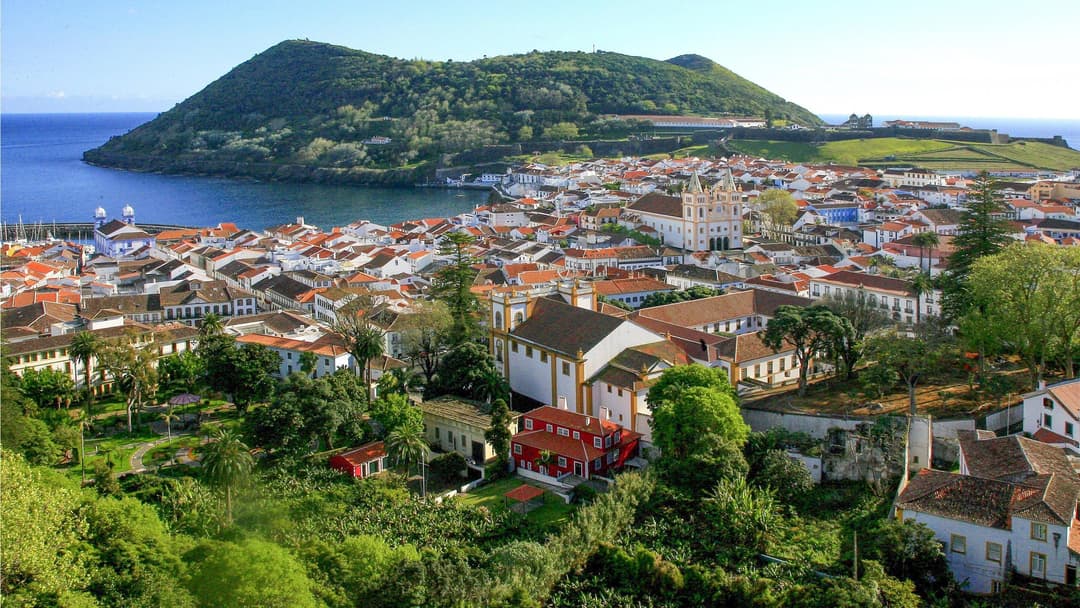
Terceira's UNESCO-designated Angra do Heroísmo is filled with cobbled streets and grand civic buildings that are a reminder of its prosperous past as a port city.
First settled by Portuguese navigators in the mid-15th century, Terceira quickly became one of the Azores’ most important islands. Its strategic position along Atlantic trade routes turned it into a vital port of call for merchant fleets traveling between Europe, Africa and the Americas. Over time, this steady flow of people and goods made Terceira an economic center of the archipelago—an island shaped as much by global exchange as by local tradition.
That legacy is still visible today. Coastal villages such as Porto Judeu, São Sebastião and Altares reflect centuries of maritime life in their harbors and slipways, and through traditions such as fishing and boatbuilding. In Angra do Heroísmo, a UNESCO World Heritage site, cobbled streets, colorful facades and grand civic buildings speak to the island’s former prosperity and its central role during the Age of Exploration. Terceira is an island shaped by connection—defined by the global influences that have passed through it.
Faial: An Island Remade

Parts of Faial are still covered in ash from when the Capelinhos volcano erupted in 1957.
Faial is an island where active change is visible. In 1957, the Capelinhos volcano erupted along the island’s western edge, burying farmland and villages beneath ash and adding nearly a square mile of new land. The eruption reshaped both the coastline and daily life, prompting waves of emigration as many residents left for North America—particularly the United States and Canada—in search of stability.
Today, Capelinhos remains a stark reminder that the Azores are still being formed, with an ash-covered landscape revealing geological upheaval within living memory. At the same time, Faial continues to look outward. In Horta’s harbor, marina walls are painted by passing sailors, and guests raise a glass at Peter Café Sport—a longtime gathering place for mariners and explorers. These symbols reflect Faial’s enduring identity: an island shaped by upheaval, movement and reinvention.